
Updated
Head spa for
dry scalp.
Hydration sessions 60–90 min · $85–$135 · Typical cadence every 4–8 weeks · Shoreline + Lynnwood, est. 2022
Reviewed by the D4 Season team: licensed massage therapists and certified estheticians at Seattle's first specialized head spa, established 2022.
— The signals
What a dry scalp actually feels like.
You usually notice it about ten minutes after you rinse. The skin under your hair pulls tight, the way the backs of your hands feel after washing dishes without gloves. Later comes an itch you can't quite pin down. By day two, there are fine white flakes on a dark collar. It's mild, but it never fully goes away.
A dry scalp behaves like dry skin anywhere else. The outer layer loses moisture faster than it can hold it, so the skin feels tighter and rougher than it should. Hair makes it harder to deal with. You can't see the skin easily, and you can't rub lotion into it the way you would on your hands. Most of what touches it all week is shampoo, which is made to remove oil.
- Tightness or a pulling sensation within minutes of washing, before the hair is even dry
- Fine, powdery white flakes on your parting, your shoulders, your hairbrush
- An itch that gets worse in winter and eases off in summer
- A scalp that looks dull or feels rough under your fingertips
- Roots that turn static-prone or brittle
— Why it happens
Where the moisture goes.
If several of those sound familiar, the answer is rarely to wash more. Washing less won't solve it on its own either. What helps is changing how you wash. Scalp dryness almost always comes from a few ordinary causes stacked together. The usual ones are water that's too hot, a clarifying shampoo used daily instead of now and then, and high dryer heat held too close. For those of us around Puget Sound, add the heating season that shows up every year.
The Seattle-winter effect
From roughly November through March, homes and offices around Shoreline and Lynnwood run the heat, which pulls humidity out of indoor air. The cold air outside holds little moisture to begin with. Your scalp goes back and forth between the two a dozen times a day. Add the long, hot showers everyone takes in the dark months, and you get the usual winter pattern: tight, itchy and flaking by January.
That's why hydration requests go up every winter at both of our studios. It's also why some guests switch from a 60-minute session to the 75- or 90-minute versions between November and March.
Everyday habits that make it worse
The daily details matter as much as the season. Water hot enough to redden skin strips the scalp's thin film of natural oil. Sulfate-heavy shampoo formulated to degrease can overshoot on a scalp that was never oily in the first place. A blow-dryer on high, parked an inch from the roots, finishes the job. None of these feel harsh in the moment, so the dryness seems to come out of nowhere.
— An honest distinction
Dry scalp or dandruff?
Not all flakes are the same, and the difference matters because what helps is different too. A dry scalp sheds small, powdery flakes and feels tight. Dandruff-type flaking tends to look and behave differently. Heavier or persistent cases should go to a dermatologist instead of a spa.
| What you notice | Dry scalp | Dandruff-type flaking |
|---|---|---|
| Flake size & color | Small, fine, white, powdery | Often larger, yellowish, oily-feeling |
| How flakes behave | Fall away easily; show up on shoulders | Tend to cling to the scalp and hair |
| Scalp feel | Tight, rough, thirsty | Greasy or irritated at the roots |
| Seasonal pattern | Usually worse in winter, easing by summer | Can flare at any time of year |
| Sensible first step | Gentle cleansing, hydration, less heat | A dermatologist's opinion if heavy or persistent |
Where a head spa fits, and where it doesn't
We're direct about this at D4 Season: a head spa is a relaxation and wellness treatment, and it isn't medical care. Mild, occasional flaking is usually fine, and we adjust the session for it. If your scalp is inflamed, sore, heavily flaking or not getting any better, see a dermatologist first. Then think of the spa as the maintenance step that follows.
— Inside the session
How a head spa adapts to dryness.
A standard head spa runs 30 to 90 minutes and moves through scalp analysis, cleansing, massage, a treatment mask and a thorough rinse. Our guide to what happens during a head spa lays out the full sequence. For a dry scalp, the steps stay the same, but your therapist makes different choices within them.
Every session on the head spa menu can be steered toward hydration, but a few suit dryness especially well. Pricing is the same at both studios.
| Session | Time | Price | Why it suits a dry scalp |
|---|---|---|---|
| D4 Signature Head Spa | 60 min | $85 | The baseline session: cleanse, massage and hydration. A sensible first visit |
| Aura Scalp | 75 min | $110 | Adds a richer mask and a longer massage. The usual pick for tight, flaky scalps |
| Luxury Head Spa | 90 min | $135 | The slowest, most layered hydration session on the core menu |
| Hydra Keravive Scalp | 90 min | $258 | A dedicated hydration system; see the Keravive scalp page |
What your therapist changes
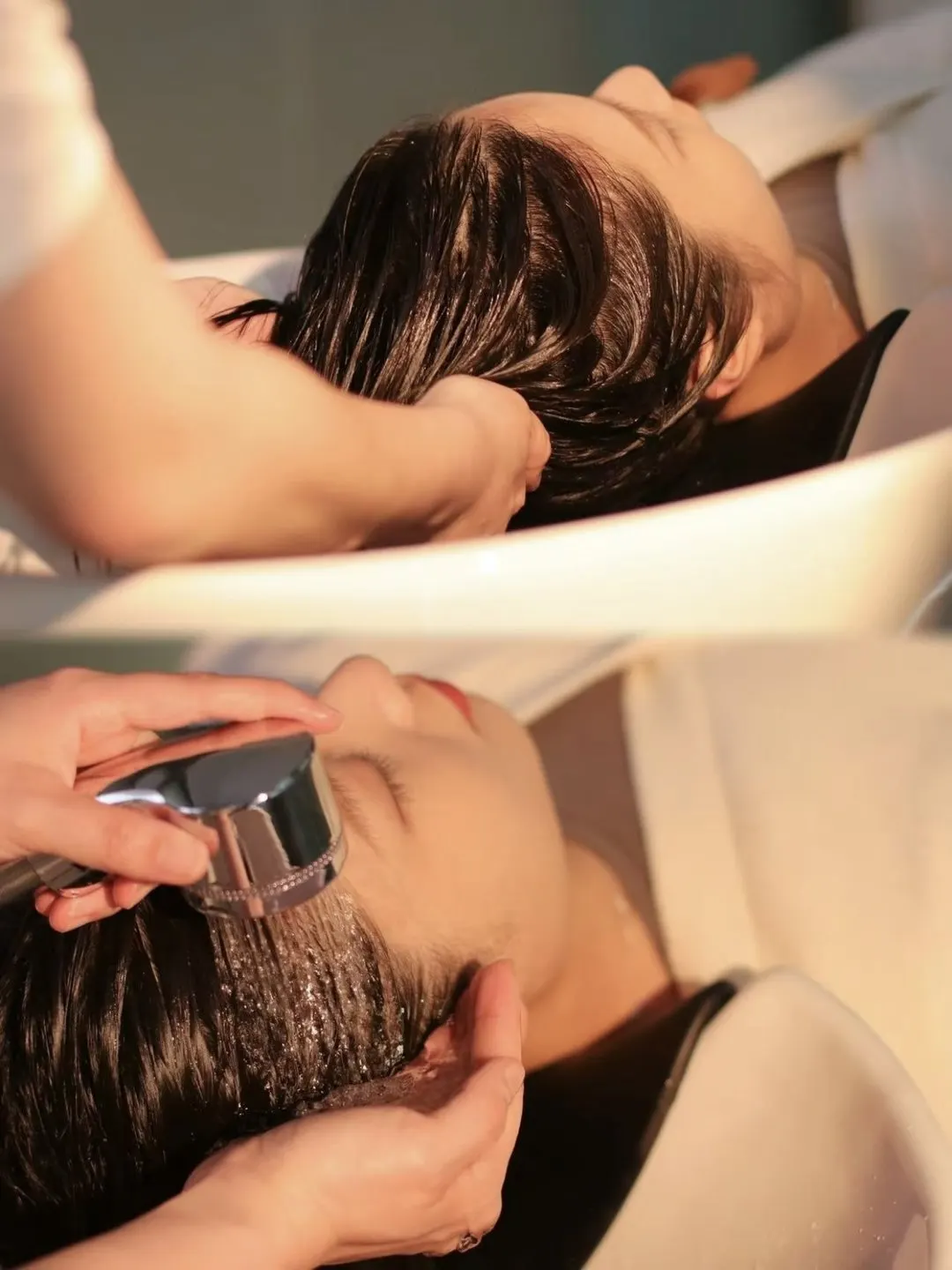
Expect lukewarm water instead of hot, a gentler cleanser in place of a deep degreaser, and much lighter exfoliation. Dry skin needs dead cells lifted off softly, without scrubbing. The hydrating steps get more time. You'll get a richer mask, often with warm steam, and a serum worked in near the end. The massage runs longer too, since a dry scalp is often tight and tender as well. Mention the tightness and the itch during the analysis at the start, because it changes what your therapist reaches for.
The longer, slower option
If you like the steam-and-ceremony style of scalp care, the Japanese head spa in Shoreline follows the same hydration approach at a slower, more careful pace.
— Between visits
At-home care that holds the line.
A 75-minute session once a month can't undo fourteen hot showers. The good news is that home care for a dry scalp is mostly about cutting back on heat and harsh products. You don't need to buy a whole shelf of new ones.
- Turn the water down: lukewarm for washing, cooler still for the final rinse
- Switch to a gentle, moisturizing shampoo; save clarifying washes for once in a while, not daily
- Let conditioner reach the scalp. Dry scalps can handle it and usually want it
- Blow-dry on low with the nozzle a few inches off the roots, or air-dry when you can
- Run a humidifier in the bedroom through the heating season, roughly November to March
- Try not to scratch. A fingertip massage settles the itch without breaking skin
Finding your cadence
Most guests settle around every 4–8 weeks, often tighter in winter and looser in summer. Our guide on how often to get a head spa explains how to find your own interval. If your scalp swings the other way in warm months, the oily-scalp guide covers that end of the spectrum.
— The quieter benefit
Beyond hydration: the hour itself.
Many people book a dry-scalp session because of the flakes, then keep coming back for the hour in the chair. There's a physical reason the chair feels so calming. The NCCIH describes a built-in counterweight to the stress response, called the relaxation response. During it, heart rate slows, blood pressure drops and stress-hormone levels fall. For a lot of people, a slow scalp massage is one of the easier everyday ways into that state.
Mayo Clinic credits relaxation practices with easing muscle tension and improving sleep quality, focus and mood. The NCCIH's overview of sleep and complementary health approaches lists relaxation techniques among the approaches studied for restless sleep. To be clear, those sources are about relaxation in general. We're not claiming that a head spa treats any condition. If you book for a dry scalp and also leave more relaxed, that's fine by us.
— Booking locally
Where to book around Shoreline & Lynnwood.
If you're local, you have two easy options. D4 Season, Seattle's first specialized head spa (established 2022), runs a top-rated studio in Shoreline at 15507 Westminster Way N Ste 7E. The second is in Lynnwood at 18500 33rd Ave W Suite C, and both have the same menu and pricing. Guests looking for a focused scalp treatment in Shoreline or the best head spa experience near Lynnwood get the same service either way. The only difference is the drive.
Hours are Monday–Saturday 10 am–9 pm and Sunday 10 am–8 pm. Come in with unwashed hair, since your therapist wants to see your scalp in its everyday state. When you book at (206) 688-9700, mention the dryness so the session is set up for hydration from the first rinse.
— Common questions
Head spa questions.
Why does my scalp feel tight right after washing?
+
Tightness within minutes of rinsing usually means the wash took more oil and moisture than your scalp could spare. Hot water and strong shampoo are the usual culprits. Try lukewarm water and a gentler formula first. If the feeling sticks around, a hydration-focused head spa (60–90 minutes at D4 Season) adds moisture back with a mask and serum instead of one more wash.
Can a head spa make dryness worse?
+
Not when the session is set up for it. Deep-degreasing treatments are made for oily scalps and would be the wrong pick here. That's why every D4 Season session opens with a scalp analysis. Mention the tightness and flaking when you book, and your therapist will use a milder cleanse, lukewarm water and a hydrating mask instead of a stripping one.
How can I tell dry scalp from dandruff?
+
As a rough guide, dry-scalp flakes tend to be small, white and powdery, and they come with tightness. Dandruff-type flaking is often larger, yellowish and oilier, and it clings to the scalp. This isn't a diagnosis either way. A head spa is a wellness treatment, and heavy, inflamed or persistent flaking is a reason to see a dermatologist before booking a spa session.
Which D4 Season session is best for a dry scalp?
+
The Aura Scalp (75 minutes, $110) is the most common pick. It adds a richer mask and a longer massage to the standard session. The 90-minute Luxury Head Spa at $135 is the slower, more layered version. On a first visit, the 60-minute D4 Signature at $85 covers the essentials and lets your therapist see how your scalp responds.
How often should I book if my scalp runs dry?
+
Every 4–8 weeks is the usual range. Dry scalps often do best toward the shorter end during the heating season, roughly November through March around Puget Sound, and can stretch longer in summer. Your therapist can suggest a personal interval after seeing how your scalp looks at the second visit.
Will washing less often fix a dry scalp?
+
Usually not on its own. Dryness has more to do with how you wash than how often. Water temperature, shampoo strength and dryer heat do most of the damage. Stretching out washes while keeping a scalding shower and a harsh formula changes little, and letting buildup sit for a week creates its own itch. Adjust the routine first, then find your frequency.
Does winter in the Seattle area really affect the scalp?
+
Yes. It's our busiest season for hydration requests. Indoor heating dries the air from November to March, the cold outside holds little humidity, and hot showers get longer. By January, that adds up to a lot of tight, flaky scalps. A bedroom humidifier, cooler rinses and a session every 4–6 weeks get most guests comfortably through to spring.
— Research & references
A head spa is a scalp massage and a full hour of relaxation. We make no medical claims about it. For neutral, non-promotional background on the wellness practices behind it, see the NCCIH on massage therapy , relaxation techniques , managing stress , traditional Chinese medicine and the Mayo Clinic on easing tension headaches . These are general educational references, not statements about our specific treatments. D4 Season is a relaxation and wellness spa, not a medical provider.
— Keep reading
Related guides & services.
- Open
Guide
Head Spa for Oily Scalp
The other end of the spectrum: deep cleansing and balance for scalps that run greasy.
- Open
Guide
What Happens During a Head Spa
The full session sequence, step by step, from scalp analysis to the final blow-dry.
- Open
Service hub
Head Spa Menu & Pricing
All eleven head spa sessions, $50–$258, Hydra Keravive included. Same pricing at both studios.
- Open
Service page
Keravive Scalp · Shoreline
The dedicated 90-minute HydraFacial Keravive hydration system at our Shoreline studio.
Ready to feel it for yourself?
Book a head spa at D4 Season, Seattle's first specialized head spa. Our top-rated studios are in Shoreline and Lynnwood, WA.